Archive for October, 2007

Clif Bar’s 2-Mile Challenge

Wednesday, October 31st, 2007

clif2mile.gif

Based on the idea that “40% of Urban Travel is 2 Miles or Less”, the folks at Clif Bar are challenging us all to “Ride Your Bike to Fight Global Warming”. Type in your address to find out what’s within a 2-mile radius, from grocery stores to bars to parks to banks, and add your own suggestions if you feel inspired; then, challenge yourself to “ride some/most/all of your trips under 2 miles”. I put in a few Flatbush-friendly destinations, who’s got more?

2mile_map.png

Biking To Kindergarten

Monday, October 29th, 2007

Felixio, originally uploaded by [Zakkaliciousness].

Another photo from Copenhagen website Cycliciousness:

Transporting kids in Copenhagen is an integral part of our bike culture. As mentioned previously in this blog 36% of Copenhageners ride their bike each day on average. This figure is bumped up to 50% between spring and summer. That translates into 850,000 bikes on the streets on a lovely summer’s day.

This fact, coupled with the fact that Danish kids start in daily daycare at the age of 1-1.5 years, means that kids need to be moved around until they’re able to ride themselves (italics mine - SF).

The post has many great photos of various human-powered conveyances allowing adults to transport kids around town (plus this lovely shot of little Felixio, doin’ it for himself). To all those who shake their heads, roll their eyes, and tell me I need to just accept that this will NEVER, EVER happen in New York City… it’s a dream I refuse to give up!

When Danish urban planner Jan Gehl talks about Copenhagen’s gradual shift from streets devoted to cars to the bicycle paradise they enjoy today, he mentions that everyone said it was simply unthinkable, that the Danish needed their cars because they couldn’t possibly walk everywhere — walking was “for Italians”! Copenhagen’s transformation began in the early ’60s, the height of the automobile age, and was something of a stealth operation, spread out over several decades before it was fully recognized as a revolution with no turning back. In my opinion the decline of the automobile age has begun, whether most of the population recognizes it or not; the time has come to start embracing other ways of getting around. New York City has the potential to lead the way, with the highest percentage of car-less households in the U.S., yet cycling is still something of a fringe activity at best here.
Fortunately there are many examples to admire and emulate: in European cities from Amsterdam to Munich to the gold standard, Copenhagen, using a bicycle to perform everyday tasks is the norm, all year round (notice the patch of snow on Felixio’s route to kindergarten). Everyone from small kids to senior citizens does it, and they are only healthier for it.

Beans, originally uploaded by [Zakkaliciousness].


Three Wheeler, originally uploaded by [Zakkaliciousness].


The Royal Danish Post, originally uploaded by [Zakkaliciousness].

It’s not a sport, or a pastime, or a hobby. It’s just transport.

Thanks to Cycliciousness for another dose of inspiration.

Support BCUE with Eco-Shopping!

Saturday, October 27th, 2007

Brooklyn Center for the Urban Environment does great work educating children and adults about the built and natural environments of New York City. Their activities range from walking tours of Brooklyn neighborhoods to canoing the Gowanus Canal to a bicycle tour of Newtown Creek, and they have sponsored the Green Brooklyn Conference, — “Brooklyn’s largest showcase of green and sustainability issues, programs, and products” — at Borough Hall for the past three years. They also work with NYC public schools to educate children about science and ecology, and have partnered in the creation of environmental leadership programs in three Brooklyn high schools located in Bushwick and Williamsburg: the Academy for Urban Planning, the Green School/Academy for Environmental Careers, and the Academy for Environmental Leadership.

So it’s fantastic news that we can support both environmental education in Brooklyn and green businesses by shopping at shopbcue.org, where up to 25% of the purchase price will help fund BCUE’s programs:

Clicking through shopbcue.org allows you to:

  • Limit the environmental impact of your purchases
  • Demonstrate your support for green businesses and manufacturers
  • Inform companies of the issues that are important to you as a consumer
  • Donate up to 25% of your purchase to Brooklyn Center for the Urban Environment

The list of vendors includes companies that demonstrate environmentally or socially conscious principles in their products or practices, including:

3R Living
Alternative Energy Store
Apple iTunes
Aubrey Organics
Audible
Bag, Borrow or Steal
Design Public
eBay
Evogear
GAIAM
Gardens Alive!
Global Exchange
Green Batteries
Green Nest
Greenfeet
Greenloop
Native Remedies
NOVICA
Office Depot
Only Natural Pet Store
Organic Bouquet
Our Green House
ParkSeed
Staples
Taraluna
The Green Office
TreeGivers
VivaTerra
Vivavi
WindowBox

While many of these are businesses I would expect to see in a partnership like this (go 3R Living!), it’s particularly nice to see iTunes and ebay on the list.

Freegans in the ‘Hood

Thursday, October 25th, 2007

I’ll admit it: I find the Freegan movement fascinating. The mainstream media has also been flirting with this particular manifestation of environmentalism lately, though i suspect that relationship will be short-lived. Freeganism has been a featured topic in the New York Times, the L.A. Times, Newsweek, and MSNBC, amongst others. If “Sex and the City” were still on the air, one of “the girls” would undoubtedly be sleeping with a hunky freegan, admiring his “green” credibility while struggling with the “ew” factor of his food (and clothing!) coming from dumpsters.

In my opinion anyone who is keeping useful items — including food — out of our landfills is performing a public service, whether the motivation is opposition to rampant consumerism or basic lack of funds. This activity is not born exclusively of some post-grunge ennui, nor are its practitioners confined to twenty-something anarchists and homeless people. Once upon a time folks throughout the world were offended by the idea of discarding gadgets because they were last year’s model or throwing away edible produce because it didn’t fit cosmetic standards: a 19th century painting called “Les Glaneurs” by Jean-François Millet depicts French peasants collecting leftover grain after a harvest, and this ancient practice, known as “gleaning”, is explored in the setting of contemporary France in Agnes Varda’s documentary “The Gleaners and I”. It turns out that even in today’s throwaway culture some people are disturbed enough by the amount of waste our society produces to make the ultimate statement of sustaining themselves on it.

To give the whole thing a local spin, each of the articles I’ve read has mentioned a woman named Madeline Nelson, who happens to live around the corner from me here in Flatbush. Her story is particularly compelling because she is always described as a “real grown-up” who renounced a corporate job and its accompanying lifestyle to opt out of hyper-consumerism. In talking about her life as a freegan, she is careful to point out that she still works, just not for money, and the fact that her previous life was built on the economic model most of us are familiar with gives her story a reference point. (Stories about Adam Weissman, often cited as the de facto leader of NYC’s freegan movement, always make sure to mention that he is 29 years old, lives with his parents, and “doesn’t work”… though anyone familiar with the number of freegan activities going on around the city — not to mention how much press they are getting — can surely recognize that a tremendous amount of work is involved, despite not having a salary attached.)

Although the mainstream media’s coverage of freegans likes to obsess on the perceived deprivation (and, by extension, misery) that must surely accompany a life based on not buying anything, when I see Madeline biking or walking through the neighborhood (always on her way somewhere), she just doesn’t seem miserable to me. So I ask you, dear readers: How can that be?

Science Barge - Powered By Nature!

Wednesday, October 24th, 2007

Science Barge - Powered By Nature!, originally uploaded by Sustainable Flatbush.

Finally visited the Science Barge during GreenHome NYC’s Green Buildings Open House.

The Science Barge is a sustainable urban farm. It demonstrates renewable energy supporting sustainable food production in New York City. The Science Barge grows tomatoes, cucumbers, and lettuce with zero net carbon emissions, zero chemical pesticides, and zero runoff. Operating from May to October in 2007 and 2008, the Barge tours waterfront parks in Manhattan, hosting thousands of visitors and public school students.

For more photos of this event, check out the Sustainable Flatbush Flickr gallery.

Step It Up 2007 at Grand Army Plaza

Wednesday, October 24th, 2007

stepitup_2007_logo.gif

Some of you may have participated in the Step It Up rallies held back in April of this year, when people all over the country gathered in iconic locations, calling on Congress to “Cut Carbon 80% by 2050″. Next weekend will be the next phase of events, and Brooklyn is hosting a big one:

On November 3rd the Green Guide for Kids will join with thousands of others across the country in calling on our politicians and candidates to take steps to meet the goal set on April 14th. We will gather at Grand Army Plaza and work together to create a banner that will ask politicians and candidates: Who Is A Leader? A photograph taken of all participants with the banner will be sent to Congress and candidates running for president one year to the date before the federal elections.

Thanks to Deirdre Gill of the Green Guide for Kids for this tip. Check out her blog, “an online resource for kids [and adults!] to find ideas, information, and inspiration to go green”!

Say No to Excessive Packaging!

Wednesday, October 24th, 2007

One big source of trash for those of us who shop online and mail order is excessive packing materials. Some companies are worse offenders than others, and hopefully this instance cited on Organic Picks is not the norm:

2007_10_15_amazon_packaging.jpg
photo: Organic Picks

Yes, the small Pyrex bowl on the left is the purchased item!

As the post points out, we concerned consumers can have an impact on the companies we shop with by praising those with eco-conscious packaging and objecting to practices like the above. This in turn raises the issue of excessive packaging, period. How many times have you been tempted to use a hacksaw to open one of those ridiculous plastic clamshell bubbles in order to free the small item (usually electronics) contained within? Ever wondered why so many food products are packaged in both a plastic bag AND a box (most cereal, for example)? Even those who conscientiously harvest and recycle all the cardboard from these conveyances will be faced with a pile of plastic that can only go in the trash — where it will remain for generations.

Though you wouldn’t know it from a typical shopping experience today, sustainable packaging design is being explored and embraced by many companies. It is currently a work-in-progress with much “greenwashing” in evidence (a “compostable” plastic container that gets thrown in the trash is arguably no different from any other plastic container, as it will not break down in a landfill… only if it is actually composted). But many companies have already voluntarily reduced their packaging and seen dramatic reductions in their shipping and storage costs. Fast Company’s recent article, 50 Ways to Green Your Business cites some dramatic examples:

1 At $100 a ton, feeding a landfill is pricey. But in the past two years, General Mills (NYSE:GIS) has turned its solid waste into profits. Take its oat hulls, a Cheerios by-product. The company used to pay to have them hauled off, but realized they could be burned as fuel. Now customers compete to buy the stuff. In 2006, General Mills recycled 86% of its solid waste, earning more from that than it spent on disposal.

8 Hamburger Helper helps your hamburger … save the planet? This year, General Mills redesigned the packaging of Mom’s old standby, shaving off 20% of the paperboard box without shrinking its tasty contents. The astounding result: 500 fewer distribution trucks on the road each year.

10 Taking the packaging revolution a step further, the liquid-laundry-detergent industry, goaded by Wal-Mart, has cut the size of its bottles by 50% or more by concentrating the liquid to two and sometimes three degrees of magnitude. Unilever’s triple-concentrated All Small & Mighty detergent has saved 1.3 million gallons of diesel fuel, 10 million pounds of plastic resin, and 80 million square feet of cardboard since 2005. This fall, Procter & Gamble (NYSE:PG) is converting its entire collection of liquids to double concentration.

(The rest of their list is pretty interesting too.)

As consumers, the more we educate ourselves about the consequences of excessive packaging and use our wallets to vote for alternatives, the more manufacturers will be compelled to respond with real solutions. And if the solutions also benefit those companies, well, isn’t that how things should be?

Red Hook Harvest Festival this Saturday!

Thursday, October 18th, 2007

Red Hook Harvest Festival invite

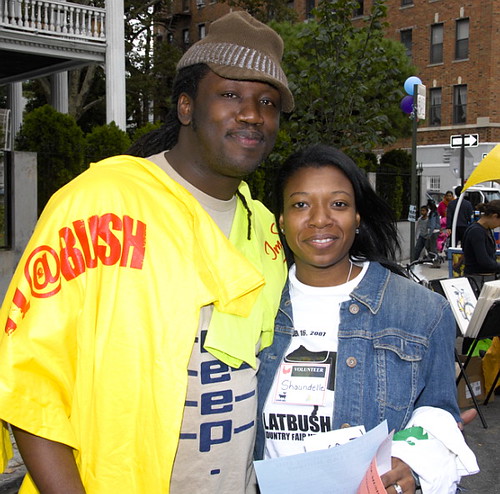
We represent Fl@tbush

Thursday, October 18th, 2007

We represent Fl@tbush, originally uploaded by Flatbush Frolic.

For all those fans of the Fl@bush t-shirt featured in posts on this blog and others (watch the film and you’ll see it!), credit where credit is due:

Gerald Dumay, designer of the Fl@tbush logo and t-shirts smiles alongside Shaundelle Moore, a stellar FDC Frolic volunteer .
(from the Flatbush Frolic’s Flickr page)

Hey Gerald, thanks for the cool design!

That’s What I’m Talking About…

Tuesday, October 16th, 2007

According to this NY Times article, Seattle is leading the nation when it comes to recycling. It is among a growing number of cities, particularly on the West Coast, who do curbside collection of food scraps mixed with yard waste; this mixture is delivered to a high-tech composting facility, Cedar Grove Organics, and two months later the results will be sold at garden supply stores by the bag.

“This is the cool side of trash,” Cedar Grove’s founder, Steve Banchero, said of the process, which is on recycling’s cutting edge.

The company, the major composter in this area, will soon have much more trash coming its way because Seattle is making food waste yet another mandatory recycling ingredient in its already long list.

“The food-waste issue is the new frontier for recycling advocates,” said Kate Krebs, the executive director of the National Recycling Coalition. “It’s the next big chunk.”

Seattle now recycles 44 percent of its trash, compared with the national average of around 30 percent, which makes it a major player in big-city waste recovery. Its goal, city waste management officials said, is to reach 60 percent by 2012 and 72 percent by 2025.

Obviously, a key element for the success of recycling programs is the creation and nurturing of markets for recycled materials:

Waste paper is now commanding about $90 a ton throughout the United States, which makes it possible to turn a profit by loading it onto ships instead of dumping it into landfills.

Not to sell it “would be like burying money,” said Chaz Miller of the Environmental Industry Associations, which represents the private waste service industry. Because of that, collecting paper for recycling is at an all-time high.

God forbid anyone should accuse us New Yorkers of “burying money”… but according to my source at the Department of Sanitation, New York City is only recycling a fraction of the paper we could be. Here are the “mixed paper” items that New Yorkers can recycle:

  • white, colored, and glossy paper (staples OK)
  • mail and envelopes (window envelopes OK)
  • wrapping paper (remove ribbon and tape)
  • smooth cardboard (food boxes — remove inside & outside plastic wrappers — shoe boxes, tubes from paper towel and toilet paper rolls, cardboard from product packaging)
  • paper bags
  • cardboard egg cartons and trays
  • newspapers, magazines, and catalogs
  • phone books, softcover books (paperbacks, comic books, etc.; no spiral bindings)
  • corrugated cardboard (flattened boxes)

But when will WE be able to recycle OUR food scraps? I’m getting really tired of the West Coast kicking our a** when it comes to sustainability!